Project name: Addressing Environmental Injustice in Detroit – A Pilot Project
PI: Richard L Neitzel
Team: Abas Shkembi, Lauren M Smith, Xin Zhang, Alexandra Ulery, Mora McPherson, Natalie Conti, Jie He
Source of funding: University of Michigan School of Public Health IDEAs
Dates: September 2023 – present
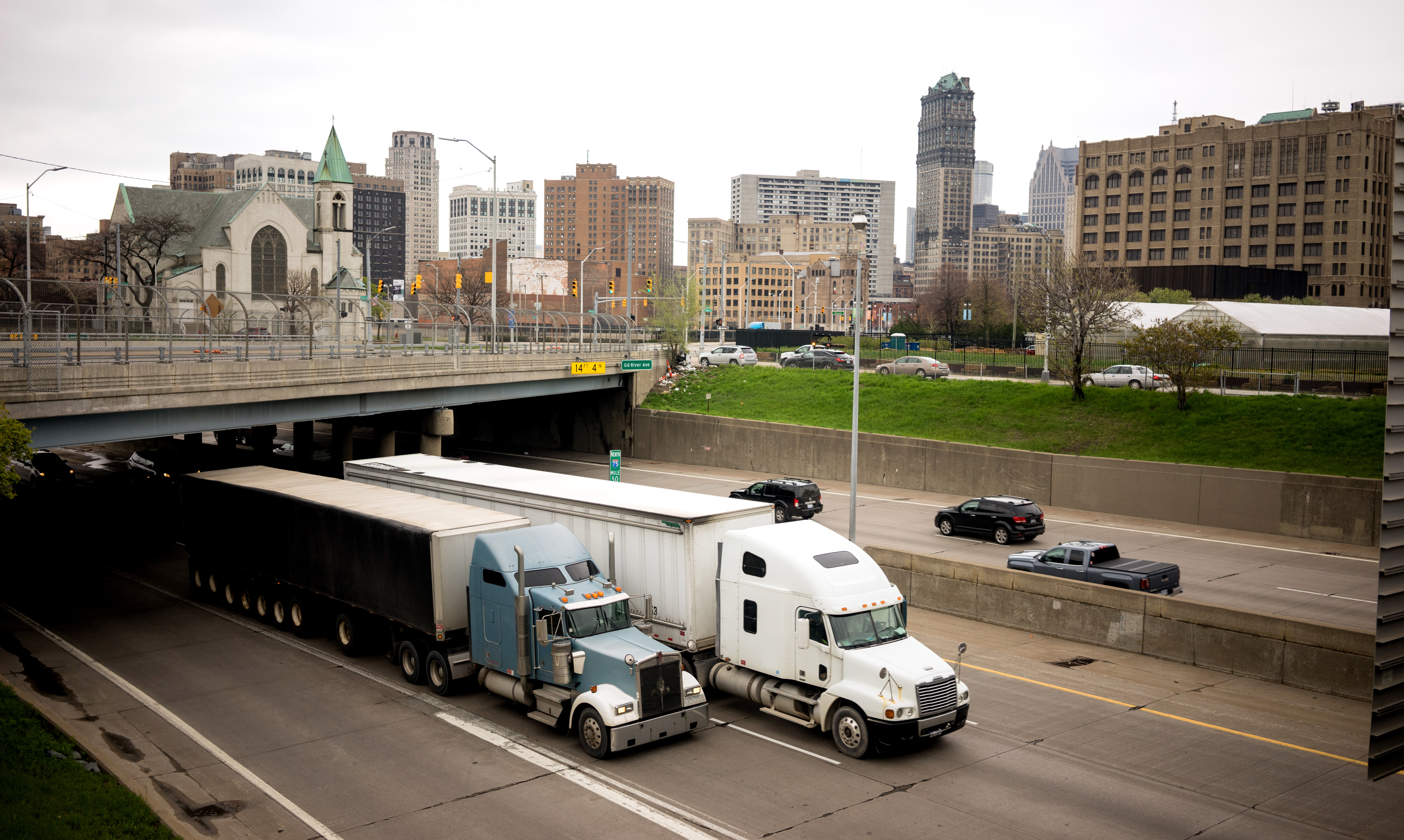
Description: Thriving, Black communities such as Paradise Valley and Black Bottom were destroyed by the intentionally racist siting of I-375 in 1950s Detroit. Recently, Detroit received $100 million to redesign I-375 for the “righting of this past wrong.” The six-lane, 55-mph freeway will be replaced with a nine-lane, 35-mph boulevard. The replacement hopes to better connect neighborhoods, yet its impacts on pollution and human health have not been prioritized.
The Michigan Department of Transportation (MDOT) estimates that noise levels near I-375 range from 66-72 decibels (dB) – hazardous to cardiovascular and hearing health. While MDOT predicts these harmful noise levels may increase by up to 5.3 dB by 2040, MDOT does not consider impacts significant unless the change exceeds 10 dBA, so the agency’s I-375 assessment yielded a Finding of No Significant Impact (FONSI). Noise mitigation was deemed “not reasonable” despite nearly one quarter of the impacted residential locations experiencing increased noise.
We believe this finding is questionable, as evidenced by recent complaints from residents, as well as the reevaluation of excessive noise pollution following the recent 2018-2022 redevelopment of I-75 in metro-Detroit, which was another MDOT FONSI. The area most heavily impacted by the I-375 redevelopment remains predominately Black today. These impacted, historically redlined neighborhoods near I-375 are heavily polluted, and noise pollution is likely to increase over time, contributing to residents’ overall exposure burden. These communities have been denied remediation due to the FONSI. These are all hallmarks of environmental injustice.
Methods:
- MDOT used several Common Noise Environments (CNEs) in their assessment. We propose a combination of conventional, short-term stationary measurements like those made by MDOT, using the same CNEs, as well as novel mobile measurements. Stationary measurements provide limited information about the spatial and temporal influence of the environment on noise and require substantial assumptions about environmental impacts on noise propagation. Our novel measurements will be made during morning, evening, and night and will incorporate changes over time with fine spatial estimation. Our study will update MDOT’s obsolete data and provide baseline noise pollution data for future proposals to prospectively monitor noise and air pollution in the area. The proposed study will evaluate whether these or other areas are exposed to excessive noise and investigate the validity of MODTs FONSI.
- We will use stationary noise monitors to measure equivalent continuous average (LEQ) 1-hr noise levels during morning, evening, and night at the 13 MDOT locations to validate MDOTs measurements. We will use Type 1 Sound Level Meters (SLMs) set to MDOT criteria and mounted on tripods at 3-ft height. The total duration of measurements will be 39 hours (13 locations x 3 measurements/day x 1 hr/location). Our results will be compared to MDOTs measurements; levels ±3 dBA will be considered in agreement. Methods for novel mobile measurements (SA 2) To overcome the limitations of stationary monitoring, we propose to drive an electric vehicle through a series of preset courses during different times of day and days of the week while continuously measuring noise using a Type 1 Sound Level Meter. This previously piloted mobile methodology will allow us to objectively evaluate the spatial and temporal variability of noise levels and to consider those changes in the context of different environments (e.g., business, residential, park space, major roadways).
- We have outlined four routes for sampling. Two of these routes will take 30-min to drive: 1) outer bound of the project area and 2) outline tracing the existing I-375 freeway. We will also complete two yellow, 30-min residential routes: 3) Brewster Homes in the NW and (4) Lafayette Park in the SE. A complete sample series will take 2 hrs (4 routes x 30 min). We will complete as many sampling campaigns as possible. The routes will pass by the stationary measurement sites, allowing for comparison fixed vs mobile methods. We will collect 1-min LEQ measurements. We will use these measurements to estimate 1-hr, 24-hr, and other time- and location-specific averages.
Objectives
- Reevaluate Michigan Department of Transportation’s (MDOT) I-375 noise assessment. We will measure noise at locations monitored and modeled by MDOT in 2017 to identify impacted areas based on health impact using existing recommended limits.
- Develop and test novel mobile methods for assessing noise pollution. We will utilize vehicle-based monitoring to examine finer-scale spatial and temporal variation for better prediction of noise-related health impacts.
 Exposure Research Lab