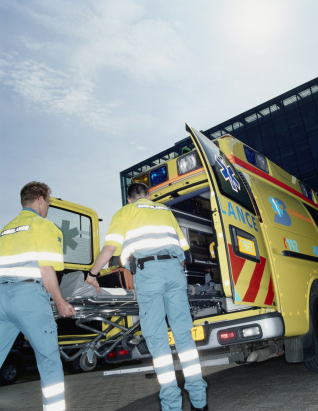
Project name: Evaluating Occupational Stressors and Assistive Technologies to Enhance EMS Safety
Investigator(s): Rick Neitzel (PI), Oshin Tyagi (PI), Mousa Alsulais (Co-I)
Team: Mousa Alsulais, Jun Hu, Jacob Um, Fei Lin
Source of Funding: Ministry of Education of Saudi Arabia; Center for Occupational Health and Safety Engineering (COHSE), University of Michigan; Global Public Health, University of Michigan School of Public Health
Dates: August 2024 – December 2026
Description: Emergency medical service (EMS) clinicians in the United States experience injury rates four times higher than the national average for all occupations (Maguire et al., 2023). While EMS providers play a critical role in public safety, their occupational health remains understudied, especially in regions like Saudi Arabia, where limited data is available on injury rates.
This study examines how heat, noise, psychological stress, and musculoskeletal strain affect EMS providers in Saudi Arabia and the United States. Using smartwatch-based noise and heat exposure measurements, validated surveys for psychological stress and musculoskeletal disorders, and heart rate monitoring, the study aims to quantify these occupational stressors and their physiological impact on EMS personnel.
Additionally, the study includes a usability evaluation of passive low-back exoskeletons, where EMS providers will perform simulated emergency tasks such as stair climbing, CPR, and patient transport. The goal is to assess how exoskeleton use impacts comfort, exertion, and task performance using validated usability metrics (TAM, RPE, RPD, NASA TLX). Post-experiment interviews will provide qualitative insights into user experience and acceptance.
Objectives:
- Quantify occupational exposures to heat and noise among EMS providers using smartwatch data.
- Assess psychological and musculoskeletal strain using validated surveys and heart rate monitoring.
- Compare regional differences in combined exposure levels between Saudi Arabia and the U.S.
- Evaluate the usability of passive low-back exoskeletons by assessing comfort, perceived exertion, and task performance.
- Determine key factors influencing exoskeleton acceptance in EMS operations.
Publications: None to date
 Exposure Research Lab