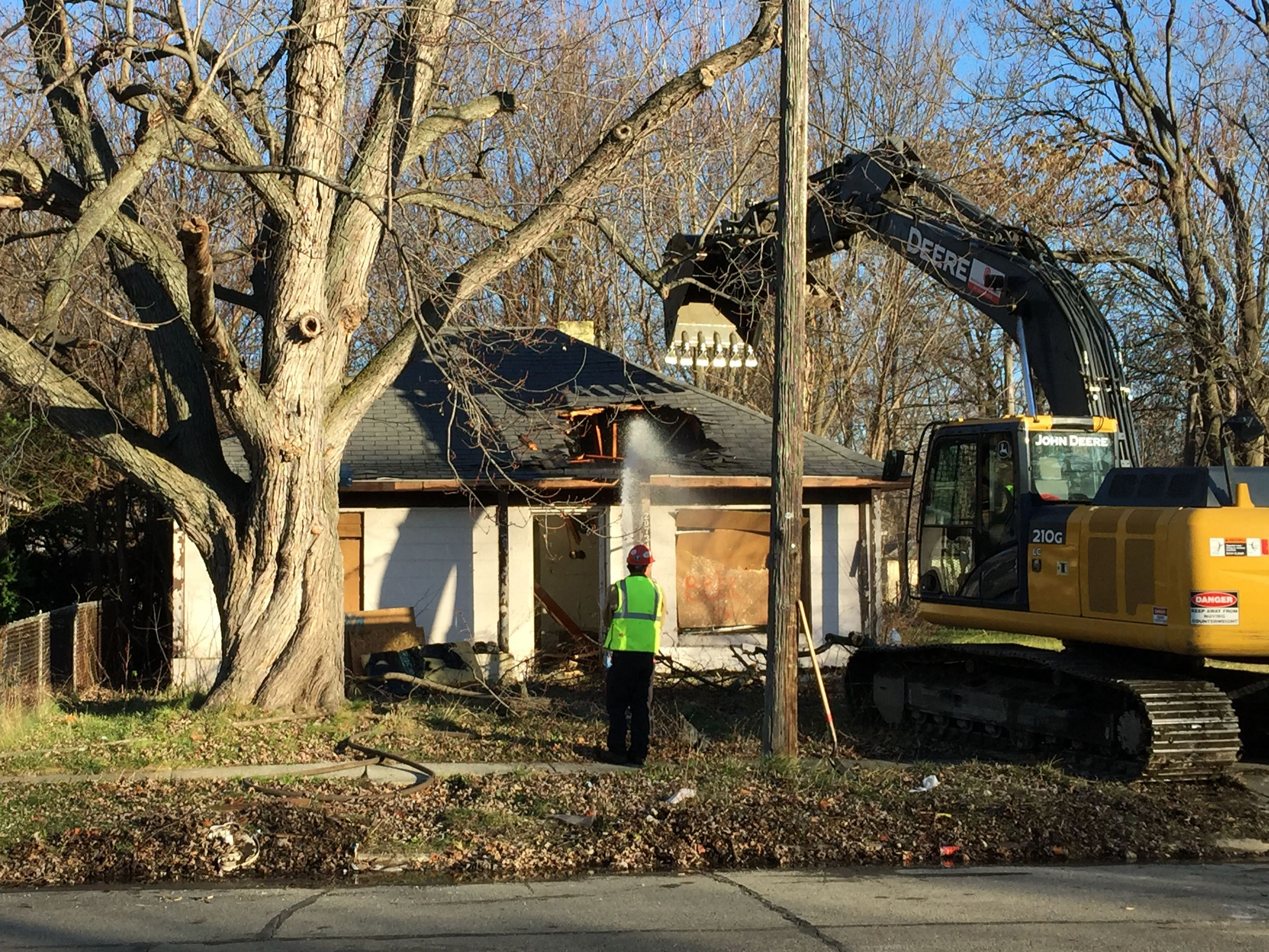
Project name: Evaluation of asbestos during blight demolition in Detroit
Dates: 2016-2017
Investigator(s): Alfred Franzblau (PI), Richard Neitzel (Co-I)
Team: Stephanie Sayler, Xenia Chan, Katherine Galen, Emily Nash, Michael Sacchetti, Taylor Tarpey
Source of funding: A pilot grant from the University of Michigan Center on Lifestage Environmental Exposures and Disease, funded by grant P30ES017885 from the National Institute of Environmental Health Sciences, National Institutes of Health
Description: Many cities in the US as well as in other countries are engaged in demolition programs to remove abandoned residential dwellings to resolve urban blight and revitalize city centers. From 2014 to July 3, 2019, the City of Detroit demolished 18,304 abandoned residential dwellings at a cost of $310 million. The rapid removal of abandoned houses is complicated by the possible presence of asbestos. The most important risks to human health resulting from lower levels of exposure to asbestos (in non-workplace settings) are lung cancer and mesothelioma.
Traditionally, asbestos was used in a variety of common construction materials, including duct and pipe insulation, cement, siding, flooring, roofing, and in sealants, caulks, and glazes, throughout the 20th century, until it was partially banned in the 1970s. Asbestos may also be present in vermiculite insulation. Initially, building materials were divided into two types, friable and nonfriable, based on the likelihood of the release of asbestos fibers.
Working with the City of Detroit, researchers obtained information on all abandoned residential dwellings demolished from 2014 to 2017. Using an online database, investigators randomly sampled 605 abandoned residential dwellings, which were typically single-family houses consisting of two stories that were constructed between the years of 1885 and 1974. Researchers analyzed the presence, type, and amount of asbestos-containing materials, and the associated abatement and demolition costs.
Results: Of the 605 abandoned residential dwellings analyzed, researchers found that asbestos-containing materials (usually multiple types) were present in 95% of demolished houses. The materials most often found to contain asbestos included flooring and roofing – both of which were the asbestos-containing materials in approximately one-half of the samples – as well as siding and duct insulation.
The material containing the greatest fraction of asbestos was duct insulation. The type of asbestos generally present was chrysotile. Only eight (1%) of the abandoned residential dwellings contained commercial amphibole asbestos; another 36 contained vermiculite. The total cost of demolition averaged $13,645 per home, of which 20.1% was asbestos abatement.
This study contributes information about the nature and extent of asbestos-containing materials in abandoned residential dwellings, which can provide part of the foundation for assessing possible asbestos-containing air emissions during the demolitions of abandoned residential dwellings, and the nature or extent of pre-demolition abatement that may be needed (if any) to protect the public’s health.
Publications:
 Exposure Research Lab